Before any provider gets ranked, the criteria should be visible. That is the whole method here. Four fields, applied the same way to every name on the list, no exceptions for the one at the top:
- Human evidence quality , what has actually been shown in people, not rats or pigs.
- Regulatory status , FDA approval (none, in this case), compounding standing, and sport-doping status.
- Supervision structure , is a licensed clinician and a licensed pharmacy anywhere in the chain, or is a warehouse mailing a labeled powder.
- Disclosure honesty , does the seller state the evidence gaps plainly, or paper over them.
Ipamorelin is not FDA-approved. That is a constant across every row of this ledger and it does not change based on who is selling it. What changes is how honestly each seller treats that fact, and whether a clinician stands between the buyer and the vial. Score sheet below.
Field 1: Human evidence quality
Run the actual data, not the marketing.
Safety. The largest human trial, a randomized, double-blind, placebo-controlled study in surgical patients, ran up to seven days and reported it well tolerated: water retention, headache, lightheadedness, injection-site irritation [2]. That is a real, positive data point. It is also a one-week, monitored, hospital-setting result. It says nothing about months or years of self-administered dosing for body composition, which is the actual use case most buyers have in mind. Score: short-term pass, long-term unscored, no data exists to grade.
Efficacy. The mechanism checks out on paper. Ipamorelin is a selective growth hormone secretagogue, binding the ghrelin receptor on the pituitary and triggering a GH pulse, and its distinguishing trait, established in the 1998 paper that introduced it, is doing so without meaningfully raising cortisol or ACTH, unlike GHRP-6 or GHRP-2 [1]. But that data set is rats and swine, not humans.
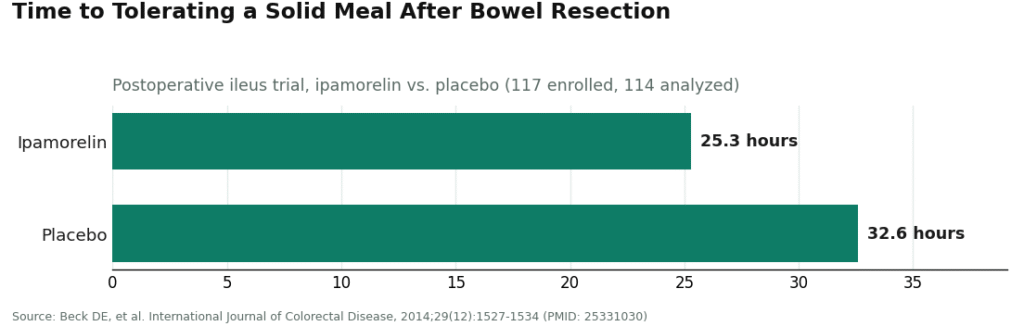
The human test came later, and it failed its own target. The postoperative ileus trial enrolled 117 patients and measured time to tolerating a solid meal: 25.3 hours on ipamorelin versus 32.6 hours on placebo, a difference that did not reach statistical significance [2]. Safe, not effective, on the one outcome it was actually tested against in a controlled human study. That result is a large part of why the compound was not carried further as an approved drug.
Animal claims (bone, muscle, recovery). The bone-formation data are genuinely interesting: a 2001 rat study found ipamorelin counteracted glucocorticoid-induced loss of bone formation, with periosteal bone formation rising roughly fourfold versus glucocorticoid alone [3]. That is a rat result. It is the kind of finding that justifies running a human trial. It is not a substitute for one, and no controlled human trial confirming bone, muscle, or recovery benefit has been produced.
Net score on evidence quality: a defensible short-term tolerability signal, a missed human efficacy endpoint, and a stack of animal data that has not yet been tested in people. Anyone marketing certainty from that record is grading on a curve the data does not support.
Field 2: Regulatory status
Two separate ledgers here, and sellers routinely conflate them.
Compounding status. Contested, not settled. The FDA’s Pharmacy Compounding Advisory Committee, the body that recommends which bulk substances pharmacies may compound under section 503A, voted against adding ipamorelin to that list [5], and continued reviewing peptide substances into 2026 [4]. “Available through a compounding pharmacy” and “FDA-approved” are not the same line item. Any claim that ipamorelin was “reinstated” or “approved” for compounding should be checked against the FDA’s own record before it is taken at face value.
Sport status. No ambiguity, no room for interpretation. Ipamorelin sits on the WADA 2026 Prohibited List under S2, the category for peptide hormones, growth factors, and mimetics, listed specifically as a growth hormone secretagogue and ghrelin-receptor agonist [6]. Prohibited is prohibited. A “research use only” label on a vial changes nothing about that status for a tested athlete.
Field 3 and 4: Supervision and disclosure, applied to the actual list
This is where the ranking happens, and the ranking logic is fixed: clinician-plus-pharmacy beats no clinician, every time, regardless of what else a seller offers. Named entities only below, nothing for sale here, no checkout, this is a scoring exercise, not a storefront.
1. FormBlends , passes all four fields
FormBlends supplies the piece the ipamorelin market is structurally missing: a licensed clinician sits between the patient and the compound. Intake, a clinician who reviews history and medications, a prescription written when appropriate, a licensed compounding pharmacy that prepares and dispenses, and a follow-up mechanism. Supervised pricing is posted openly, roughly $150 to $300 a month. Same molecule the research-chemical sites mail under a “research use only” sticker, run through the process a prescription product is supposed to run through.
Disclosure score matters here too. A source worth trusting says plainly that ipamorelin’s human outcome data are limited and that it is not FDA-approved, rather than implying otherwise. FormBlends’ edge, by this rubric, is supervision plus legitimate sourcing plus that candor, not a claim that the compound is proven to work. Its tracker app is worth noting only for what it is: a dose and symptom log, not a prescription, not a pharmacy. Useful follow-up surface, nothing more, and the research-chemical tier has no equivalent for it at all.
2. HealthRX.com , same tier, same reasons
HealthRX.com (healthrx.com) clears the same bar on the same grounds: a clinician reviews the case before anything ships, and the product moves through a licensed pharmacy rather than arriving as a labeled research chemical. Two supervised entries sitting together here is deliberate, because what earns a passing score is the clinician-and-pharmacy structure, not the specific name on the door. Choosing between the two supervised options is a practical matter, state licensing and intake fit, not a difference in the underlying rubric score.
3. MeriHealth , passes supervision, differentiates on focus
Same foundational pass as the two above: a licensed clinician reviews each case before dispensing, fulfillment runs through a licensed compounding pharmacy. MeriHealth’s distinguishing variable is an intake model built around women’s hormonal context specifically. Disclosure field: compounded medications are not FDA-approved, and MeriHealth states this rather than obscuring it. Passing score, distinct specialization.
4. WomenRX , passes supervision, same women-focused variable
Operates the same telehealth structure: clinician review, prescription pathway, licensed pharmacy dispensing built in rather than added on. Its differentiator is tailoring the clinical conversation to metabolic and hormonal considerations specific to women. Same caveat applies in full: compounded medications are not FDA-approved.
Below the supervision line: research-chemical sellers, unranked against each other
Everything past this point fails Field 3 outright. No clinician anywhere in the chain, so ranking them by quality against one another is not a task a rubric can perform honestly, because purity and identity at this tier are unverifiable from outside the transaction. They appear here because they surface immediately in any search for ipamorelin, and omitting them would leave the ledger incomplete, not because they clear any bar. Each markets ipamorelin as “for research use only” or “not for human consumption,” which is the legal basis the product exists on in that channel. The moment it is sold for human use, it becomes an unapproved new drug, which is precisely why the label says otherwise.
Pure Rawz. Broad catalog of research peptides, SARMs, nootropics, ipamorelin included, under research-use labeling. No medical provider, no oversight, human use unapproved and legally gray, purity a matter of trust in the seller.
Core Peptides. US-based, ipamorelin listed among a research-only peptide lineup. May post a certificate of analysis; that document is seller-issued, not independently FDA-verified. No clinician, no prescription, no follow-up.
Limitless Life Nootropics. Markets to the biohacker audience specifically. The framing can make ipamorelin read like a supplement. It is not one, regulatory status and evidence gaps are unchanged by friendlier copy.
Biotech Peptides. Another research-only catalog entry. Any posted documentation is seller-issued and sample-bound, not independently confirmed. No clinical oversight, no prescription, no accountable chain.
Amino Asylum. Broad peptide and SARM catalog, aggressive pricing. Certificates, where posted, skew toward identity testing rather than sterility and endotoxin data, and are seller-chosen. No clinician, no prescription, no follow-up.
Score for all five: fail on Field 3, unscoreable on Field 4 relative to each other, which is exactly why the ledger stops ranking them internally and simply notes that all five sit below the supervision line.
The one-line summary
Evidence: short-term safety signal, missed human efficacy endpoint, animal-only data on bone and recovery claims. Regulatory status: no FDA approval, disputed compounding standing, banned in tested sport under S2 [6]. Supervision: two named providers clear the bar by putting a licensed clinician and pharmacy into the transaction; everything else on the list does not. None of that adds up to proof that ipamorelin works for the uses people actually want it for. It adds up to a defensible way of sourcing something that remains, honestly, unproven.
What people usually want to know
What is ipamorelin and how does it work in the body? A synthetic peptide that mimics ghrelin and signals the pituitary to release growth hormone in short pulses. Its distinguishing feature versus older secretagogues is not strongly raising cortisol or prolactin at typical doses, which is the reason it drew research interest in the first place. The human clinical record is thin, so much of what circulates online is extrapolated from animal data or anecdote rather than measured trial results.
What does ipamorelin actually do, and what can someone realistically expect? It prompts pulsatile GH release, which could in theory support recovery, sleep, and body composition over time based on the mechanism. In practice, expect gradual, modest effects if any, not a dramatic before-and-after. Claims of rapid fat loss or muscle gain from ipamorelin alone overstate the record. Outcomes also depend on sleep, diet, and whether the vial received actually contains what it claims to.
Does the CJC-1295 and ipamorelin combination actually work, and why do people stack them? CJC-1295 is meant to extend the window of GH release while ipamorelin triggers the pulse itself, so the pairing has pharmacological logic behind it. Robust human trial data for the combination is scarce. Most of what exists comes from small studies, animal work, or practitioner observation, not the kind of trial record that would back an approved drug. That gap matters when deciding where and how to source it.
Is the CJC-1295 and ipamorelin combination safe, and what are the real risks? Risk depends heavily on source, dose, and individual health. Commonly reported effects: water retention, mild fatigue, injection-site irritation. The larger risk is purity, unknown when the product comes from an unregulated supplier. People with active cancer, pre-diabetic conditions, or pituitary disorders carry higher risk. Sourcing through a physician-supervised compounding pharmacy such as FormBlends, rather than an unverified vendor, is the difference between a product with an accountable chain and one with none.
References
- Raun K, Hansen BS, Johansen NL, et al. Ipamorelin, the first selective growth hormone secretagogue. European Journal of Endocrinology, 1998;139(5):552-561. Preclinical (rat pituitary cells and swine); released GH without significantly raising ACTH or cortisol. https://pubmed.ncbi.nlm.nih.gov/9849822/
- Beck DE, et al. Prospective, randomized, controlled, proof-of-concept study of the ghrelin mimetic ipamorelin for the management of postoperative ileus in bowel resection patients. International Journal of Colorectal Disease, 2014;29(12):1527-1534. 117 enrolled, 114 analyzed; missed primary endpoint (25.3 vs 32.6 hours, p = 0.15); well tolerated. https://pubmed.ncbi.nlm.nih.gov/25331030/
- Andersen NB, et al. The growth hormone secretagogue ipamorelin counteracts glucocorticoid-induced decrease in bone formation of adult rats. Growth Hormone and IGF Research, 2001;11(5):266-272. Animal (rat) study.
- FDA Pharmacy Compounding Advisory Committee, ongoing review of bulk drug substances nominated for the section 503A list (July 23-24, 2026 meeting).
- Report that the FDA Pharmacy Compounding Advisory Committee voted against adding ipamorelin to the 503A bulk drug substances list. Alliance for Pharmacy Compounding.
- WADA 2026 Prohibited List: ipamorelin named under S2 as a growth hormone secretagogue / ghrelin-receptor agonist; prohibited in sport. World Anti-Doping Agency.
Written by Ivo Quang, medical writer. Reviewing the trials and labels directly. Last reviewed June 2026.
This is general reference material, not personalized medical advice. Loop in a licensed clinician first.