

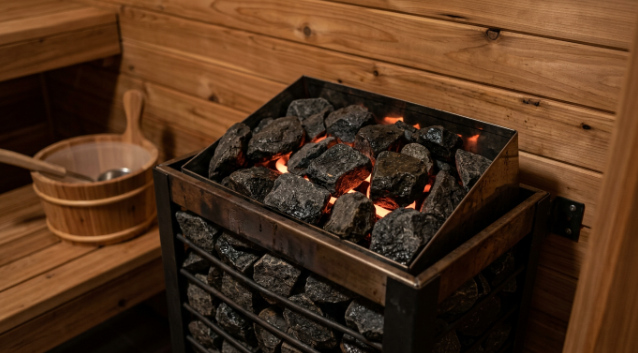
Size a sauna heater by cubic footage, not floor area: multiply width by depth by ceiling height, then match that number to a heater rated for roughly 1 kW per 40 to 45 cubic feet. A tight 4×5-foot cabin with a 7-foot ceiling comes to about 140 cubic feet, which lands most electric heaters in the 3 to 4.5 kW range. Glass doors, uninsulated walls, or a colder climate push that number up, while a well-insulated interior with cedar paneling on all sides can sit at the lower end of the range.
1. Start With Cubic Footage, Not Square Footage
The single biggest sizing mistake in a small sauna is measuring the floor and stopping there. Heat has to fill the entire volume of the room, so width times depth times ceiling height is the number that actually matters. A compact 4×4 cabin with a low 6.5-foot ceiling holds about 104 cubic feet, while the same footprint with a vaulted 8-foot peak can climb past 150. That difference alone can move a buyer from a 3 kW unit to a 4.5 kW unit, even though the floor plan looks identical on paper.
2. Match Kilowatts to Volume, Then Adjust for Conditions
The 1 kW per 40 to 45 cubic feet guideline is a starting point, not a fixed rule. A cabin built into an unheated garage or a barrel sauna sitting outside through a real winter needs to size up, often to 1 kW per 30 to 35 cubic feet, because the heater is fighting a colder starting temperature and more heat loss through the shell. A well-insulated indoor cabin in a mild climate can run efficiently at the lighter end of the range without struggling to hold temperature.
3. Account for Glass, Doors, and Wall Material
Full-glass doors and windows are popular in modern small saunas, but glass loses heat far faster than insulated wood paneling. A cabin with a large glass front or a full glass wall should generally size up one heater bracket from what the cubic footage alone would suggest, particularly in a small room where the glass makes up a larger share of total surface area relative to a bigger cabin.
4. Check Voltage and Circuit Capacity Before Buying
Heater size and electrical capacity have to line up. A 6 kW heater typically needs a 240V, 30-amp dedicated circuit, while smaller 3 to 4.5 kW units can sometimes run on a 240V, 20-amp circuit depending on the manufacturer’s spec sheet. Buyers in an older home or an outbuilding without existing 240V service should get a rough electrician quote before settling on a heater size, since the panel upgrade can end up costing more than the heater itself.
5. Leave Real Clearance Around the Heater and Stones
Every heater has a manufacturer-specified clearance to combustible walls, benches, and the ceiling, and in a small cabin that clearance eats into usable space fast. A guard rail helps reduce clearance to nearby wood surfaces on some models, which matters more in tight cabins where a few inches of saved clearance can be the difference between a bench that fits comfortably and one that feels cramped. Stone volume also scales with heater size, so a larger unit needs a deeper rock bed, which changes how much floor space the heater footprint actually takes up.
6. Don’t Forget Recovery Time Between Sessions
A correctly sized heater in a small cabin reaches temperature in 30 to 45 minutes and recovers quickly after the door opens for a new user. An undersized heater working overtime in a room it can’t quite handle takes longer to recover and cycles constantly trying to catch up, which shortens element life over years of regular use. Buyers comparing options across a full lineup, including compact models built specifically for small-footprint cabins, can check current kilowatt ratings and clearance specs at sweatdecks.com/collections/all-heaters before finalizing a floor plan, since the listed specs make it easier to match a unit to an exact cubic footage rather than guessing from a general chart.
7. Small-Space Sizing Checklist
Before ordering, confirm four things: total cubic footage including ceiling peak if vaulted, percentage of glass or exterior wall exposure, available circuit amperage, and required clearance distances from the spec sheet against the actual cabin dimensions. Skipping any one of these is the most common reason small saunas end up with a heater that either never quite reaches temperature or overshoots it every session.
8. Digital Controls Matter More in a Tight Room
A small cabin heats up fast once the wattage is right, which means temperature swings happen quickly too if the controller is imprecise. A basic mechanical thermostat can overshoot by several degrees before it cuts power, which is more noticeable in a compact room than in a larger one where heat distributes more slowly. A digital controller with a tighter temperature band, or a preset timer that lets the heater start before anyone enters the cabin, is a worthwhile upgrade in a small space specifically because the margin for error is smaller.
9. Consider How Many People Use It at Once
Sizing math based purely on cubic footage assumes an empty room. Two or three adults sitting in a small cabin add body heat and, more importantly, open the door repeatedly as people come and go, which lets accumulated heat escape. A heater sized right at the bottom of its recommended range for a room that regularly holds multiple people may struggle to recover fully between door openings, so buyers who expect frequent multi-person use should lean toward the higher end of the cubic-footage guideline rather than the lower end.
What Does the Evidence Say About Regular Sauna Use?
None of the available research ties health outcomes to heater brand or wattage specifically, since studies track sauna bathing frequency and duration rather than equipment specs. A 2018 review in Mayo Clinic Proceedings and a 2018 systematic review in Evidence-Based Complementary and Alternative Medicine both describe cardiovascular associations tied to regular sauna sessions, and a separate physiology review notes how the body responds to repeated heat exposure over time. What heater sizing actually affects is reliability: a unit that reaches and holds temperature consistently is one people are more likely to keep using on a regular schedule, which is the pattern the research associates with those outcomes in the first place.
Frequently Asked Questions
How many kW do I need for a small sauna? Roughly 1 kW per 40 to 45 cubic feet of cabin space, adjusted upward for glass, cold climates, or poor insulation.
Can a sauna heater be too big for a small room? Yes, an oversized heater overshoots temperature and cycles more than a correctly sized one, wasting power and wearing out elements faster.
Does ceiling height change heater sizing? Yes, cubic footage drives the calculation, so a taller ceiling on the same footprint needs a larger heater.
Do glass walls affect what size heater I need? Glass loses heat faster than insulated wood, so cabins with more glass usually need to size up one heater bracket.
References
- Cardiovascular and Other Health Benefits of Sauna Bathing: A Review of the Evidence, Mayo Clinic Proceedings, 2018
- Clinical Effects of Regular Dry Sauna Bathing: A Systematic Review, Evidence-Based Complementary and Alternative Medicine, 2018
- Effects of heat and cold on health, with special reference to Finnish sauna bathing, American Journal of Physiology, 2018
By Derek Holloway
